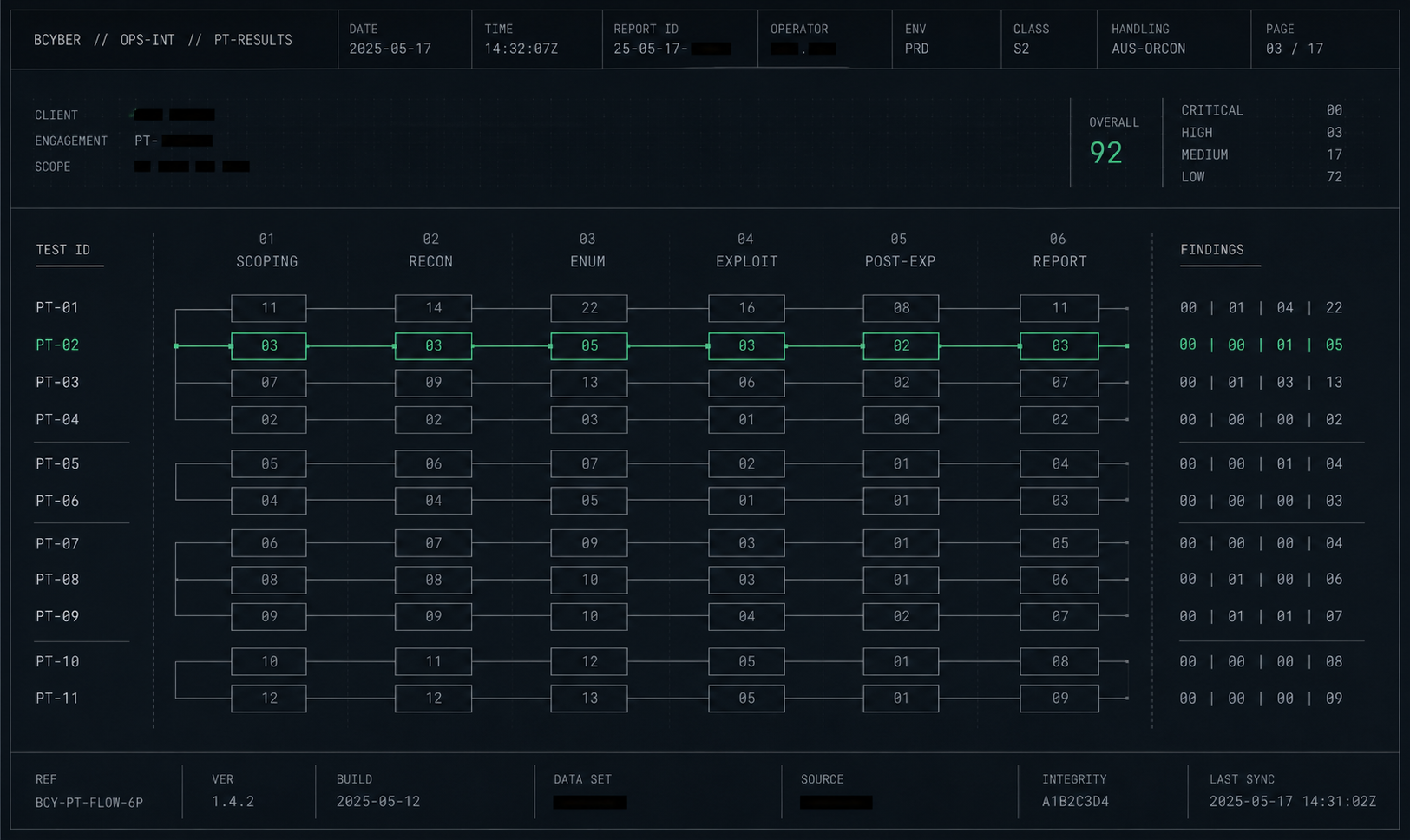
Penetration Testing Results: What They Reveal About Your Security Posture and Next Steps
By BCyber Security Team | CISSP, CISM Last updated: 26 October 2026

Penetration testing results are only useful when they translate authorised attack activity into clear, decision-ready evidence. A good report shows not just what was vulnerable, but what was actually exploitable, how the weakness was proven, what business asset was affected, and what needs to happen next. That matters in Australian environments where security teams are often working to satisfy APRA CPS 234 obligations, demonstrate Essential Eight uplift, support Privacy Act 1988 handling, and brief boards on risk in plain language.
At BCyber, we see this regularly across organisations using our GRACE Portal for executive reporting and cross-product analytics, Paradigm for policy and compliance mapping, and CyberTriage when a pentest reveals a control gap that may also require rapid incident response playbooks. With BCyber’s platform inventory of 23 policies, 9 processes, 85 courses, 1016 published articles, 606 knowledge hub entries, 12 clients, and 17 fact-find assessments, we have seen one pattern repeat: organisations improve faster when test results are treated as operational evidence, not just a PDF to archive.
What do penetration testing results actually tell you?
The evidence record behind the headline findings
Penetration testing results are the documented outcome of an authorised adversarial assessment. They are not a vulnerability scan export, and they are not a generic severity list. A high-quality result set shows what was tested, what was successfully exploited or validated, what could not be reproduced, and what the business should do next. In practice, the report becomes an evidence record that can support security teams, auditors, executives, and risk committees.
In a financial services environment, for example, a finding involving weak session management may appear technical on the surface, but the real issue may be customer account exposure or privileged transaction access. In a hospital network, the same style of control failure may affect clinical systems, patient data access, or identity trust across linked applications. In government, it may create a pathway into sensitive case files or shared admin tooling. This is why the result matters beyond technical teams: it translates control failure into business relevance.
Why findings are not the same as useful results
A finding is only the starting point. Useful results answer three questions clearly: what was found, how it was validated, and why it matters. If a report lists ten issues but provides no evidence, no exploitation path, and no business context, the organisation is left to guess what should be fixed first. That is where many reports become cosmetic rather than operational.
A practical pentest result should distinguish between potential weakness and confirmed exploitability. Not every misconfiguration is immediately exploitable, and not every exploit has equal business impact. For example, a medium-severity issue on an internet-facing application with customer data may deserve faster remediation than a high-severity issue on a segmented internal asset with no sensitive reach. Context is the difference between a score and a decision.
A pentest result is only valuable when it shows evidence, consequence, and next steps, not just vulnerability names.
What should a high-quality pentest report contain?
Executive summary that speaks to leaders, not just engineers
An executive summary should give decision-makers a plain-English view of the organisation’s security posture. It should explain the most important exposures, the likely business implications, and whether the overall picture suggests control maturity or recurring weakness. If there are limitations in scope, they should be stated clearly. If the test found a chain of issues that could lead to serious impact, the summary should say so plainly and responsibly.
For leadership, the summary is most useful when it connects technical detail to governance questions. Can the organisation demonstrate that critical controls are working? Are there gaps that could affect confidentiality, integrity, or availability? Do the issues suggest one-off mistakes or a broader control design problem? These are the questions boards and executives actually need answered. BCyber’s GRACE Portal supports this by consolidating single-dashboard visibility, cross-product analytics, compliance tracking, and executive reporting.
Scope, methodology, and the boundaries of trust
The scope and methodology section tells you what the testers actually examined and under what conditions. It should describe whether the assessment was black-box, grey-box, white-box, or hybrid, and identify the systems, networks, applications, or users included in the test. It should also note the rules of engagement, the test window, and any assumptions that shaped the exercise.
This matters because the same vulnerability may produce very different outcomes depending on what was in scope and what the testers were allowed to do. A report without this detail is hard to trust and harder to reproduce. The best reports are transparent about what was not tested. If a system was unavailable, if source code was not provided, or if a control could not be fully validated, that should be recorded. Clear boundaries make the evidence defensible and prevent overstating the result.
Findings, evidence, and the path from weakness to impact
Each finding should include severity, affected asset, exploitation path, and supporting evidence. Evidence may include screenshots, command output, logs, payloads, session details, or notes showing how the issue was reproduced. The goal is to make the result verifiable, not merely persuasive.
In practice, good testers also note whether a weakness is isolated or part of a larger attack chain. A weak password policy may be concerning on its own, but it becomes far more serious if it enables privilege escalation, lateral movement, or access to regulated data. That is where technical detail becomes business risk. If your organisation uses Profiler for behavioural intelligence, those patterns can be cross-referenced with anomalous access behaviour; if you use Perfect Storm, you can model the likely impact of chained compromise paths and resilience gaps.
Remediation guidance and ownership that can actually be used
Useful remediation guidance is specific, practical, and owned. It should not say “improve security” or “review access controls” and leave the reader to interpret the rest. It should explain what to change, where to change it, and which team is responsible.
For example:
- For web applications: fix authentication logic, validate server-side access controls, and verify token/session handling.
- For infrastructure: harden exposed services, patch vulnerable endpoints, and reduce unnecessary trust relationships.
- For identity risk: enforce MFA, tighten privileged access, and review conditional access policies.
- For logging and detection: tune alert thresholds, centralise logs, and ensure escalation paths are tested.
Ownership matters because unresolved findings often stall between teams. Security may identify the issue, infrastructure may need to patch it, and application owners may need to change code or business logic. Without an owner, the report becomes a record of uncertainty rather than progress.
How should you interpret severity, risk, and priority?
Why a severity label is not the same as business risk
Severity labels are useful, but they are not the full story. A high severity score does not always mean the issue deserves immediate business attention, and a medium issue can be urgent if it affects a critical asset. This is especially true when a system handles customer information, supports financial operations, or sits inside a trusted internal zone.
The real question is not “What is the score?” but “What could an attacker actually do here?” That shift in thinking helps leaders avoid overreacting to labels and underreacting to exposure. It also aligns with how NIST and ISO 27001 expect organisations to treat risk: as a function of likelihood, impact, and control effectiveness, not just raw vulnerability count.
The factors that should drive priority decisions
A mature triage process weighs more than technical severity. It should consider:
- Asset criticality
- Exposure to the internet or trusted internal segments
- Ease of exploitation
- Presence of compensating controls
- Likely impact on confidentiality, integrity, and availability
- Regulatory impact if the issue is abused or disclosed
These factors help determine whether a finding is a same-day issue, a short-term remediation item, or part of a planned uplift. They also help security teams explain priorities to stakeholders who are less interested in exploit mechanics and more interested in operational consequences.
For organisations working under the Essential Eight, this is especially relevant when the finding maps to application control, patch application, MFA, administrative privilege, or backup resilience. In APRA-regulated environments, the same result may also influence control assurance, third-party risk, and material security capability reporting.
Common mistakes when reading the report
One common mistake is relying too heavily on CVSS without considering context. Another is treating all findings as equally urgent simply because they appear in the same report. Some organisations also miss chained attack paths because each issue looks minor in isolation.
A better approach is to use the report as a prioritisation instrument. Which findings are exploitable now? Which ones affect the most valuable systems? Which gaps indicate a broader weakness in control design or monitoring? Those questions turn the report into a security management tool rather than a compliance artefact.
What do good results say about your security program?
Control effectiveness in the real world
Pentest results reveal whether controls worked in practice, not just on paper. Firewalls, authentication, patching, segmentation, and logging often look adequate in policy documents until they are tested under realistic attack conditions. A good assessment shows whether those controls actually stopped the attack path or whether they were bypassed, misconfigured, or absent.
BCyber’s Paradigm is designed to help teams map such results back to governance, risk, and compliance obligations, including policy automation and compliance mapping. For organisations with mature assurance programs, that matters because a pentest is not just a technical event; it is evidence for control effectiveness. In ISO 27001 terms, the result may inform corrective action, Annex A control treatment, and ongoing risk acceptance decisions.
Detection and response gaps that normal reviews miss
A strong pentest often shows whether the organisation detected the activity while it was happening. If the test successfully gained access, moved laterally, or attempted sensitive actions without timely alerting, that is an important result. It means the issue is not just that an attacker could get in, but that they may not be noticed quickly enough.
This is where BCyber’s CyberTriage is especially relevant. When a pentest exposes an active detection gap, the organisation can use incident playbooks, automated response, and forensic analysis to test whether triage can keep pace with compromise. BCyber’s positioning of 4-minute triage is intended for rapid containment workflows where timing materially changes the outcome.
Process and people issues the findings may reveal
Many findings are not caused by advanced techniques. They come from misconfiguration, weak access management, poor change control, or human error. That is useful information because it points to operational causes, not just symptoms. If the same categories of issues keep appearing across repeated tests, the problem may sit in process design rather than in any one system.
This is also where training becomes an assurance control, not just awareness content. BCyber’s course library is used to support capability uplift across security, governance, and operational teams, particularly when findings relate to privileged access, secure configuration, incident handling, or reporting discipline. In practice, repeated findings often indicate a need to reinforce policy, process, and user behaviour together.
Trend data from repeated testing
One of the most valuable uses of penetration testing results is comparison over time. Repeated assessments can show whether the organisation is improving, stagnating, or repeatedly tripping over the same class of weakness. That trend matters more than any single report because it shows whether remediation is actually sticking.
Trend analysis also helps with investment decisions. It can show which control areas are improving and which continue to produce avoidable risk. That information can support roadmap sequencing, budget planning, and board reporting. BCyber’s TopSpin capability is designed for trend analysis, capacity planning, and data-driven security decision-making, which is useful when test results need to be viewed as part of a broader resilience pattern.
Practical scenarios: what this looks like in the real world
Financial services: APRA CPS 234 and privileged access exposure
A bank or insurer may receive a pentest result showing that a privileged admin workflow can be reached from a lower-trust segment. On paper, the issue may appear as a misconfiguration. In reality, it may create a material control failure affecting customer data, system administration, and recoverability.
Under APRA CPS 234, the organisation would typically need to assess whether the finding affects information security capability, reportable obligations, and remediation urgency. The result should therefore be mapped to control ownership, evidence of remediation, and governance sign-off. In this context, a pentest report is not just a technical document; it becomes assurance evidence.
Healthcare: patient data, identity trust, and operational continuity
In healthcare, a pentest may uncover a weak authentication path into a clinical application or a shared admin account with excessive privilege. The business impact is not only privacy-related. It may affect continuity of care, availability of patient records, and trust in clinical operations.
Here, the right response is often a combination of technical remediation, access review, and validation against policy. BCyber’s Privacy in Depth offering is relevant where findings touch on personal information handling, especially under the Australian Privacy Act and related privacy obligations.
Government: internal trust boundaries and sensitive records
In government environments, a pentest may reveal that a low-severity application issue can be chained into access to sensitive case management systems or internal collaboration tooling. That is why scope and attack path matter so much. A “minor” issue can become a serious trust-boundary failure if the network architecture or identity model allows escalation.
For these programs, a good report should make the chain obvious, identify the control gap, and show whether the issue is isolated or systemic. Where necessary, scenario testing through Perfect Storm can help teams model how one weakness compounds into broader operational exposure.
How should organisations act on penetration testing results?
Triage, remediation, and deadlines
The first step after receiving results is triage. The team should sort findings by exploitability, asset importance, business impact, and exposure. That helps avoid the common mistake of treating the report as a linear to-do list. Not every issue needs the same response time, but every issue should have an owner and a decision.
If a finding is accepted as risk, that decision should be recorded and approved through the right governance path. If the result maps to APRA, Essential Eight, ISO 27001, or internal risk acceptance criteria, the evidence should be retained in the relevant control record. BCyber clients commonly use results like these to support compliance artefacts, remediation tracking, and board-level assurance.
Retesting and proof of closure
Fixing an issue is not the same as proving it is fixed. Retesting validates whether the remediation actually closed the gap or merely changed its appearance. This is especially important for critical findings and attack chains, where a partial fix may leave a different path open.
A good provider should include revalidation evidence so the organisation can show that the exposure was addressed. That evidence is valuable for audit, governance, and internal assurance. It also creates a stronger closure record for control owners and risk committees.
Communication that fits different audiences
Different stakeholders need different versions of the same truth. Executives need the business implications, risk trend, and remediation status. Technical teams need reproduction steps, logs, and precise fixes. Compliance, legal, and operations teams may need context on data handling, reporting obligations, or service impact.
A good pentest result supports all of those audiences without changing the evidence. It simply translates the same facts into the language each group needs. That is one reason BCyber’s GRACE Portal is useful for assurance workflows: it gives organisations a central place to view results, monitor remediation, and connect findings to executive reporting.
Feeding the findings into continuous improvement
Penetration testing should inform the wider security programme. Findings can update secure configuration baselines, vulnerability management priorities, detection rules, and training content. They can also highlight where policies need operational reinforcement rather than more wording.
This is where BCyber’s policy and process library helps. With 23 policies and 9 processes already in the platform inventory, organisations can connect a pentest result to policy updates, process changes, and follow-up controls instead of leaving the finding as a one-off remediation ticket. The objective is not just closure of one issue, but a reduction in repeat exposure across the environment.
What should you look for in a reliable provider and report?
Transparency in method and limits
A reliable provider should clearly state how the test was conducted, what assumptions were made, and where the boundaries were. If the report is vague about methodology, it becomes hard to trust the evidence or reproduce the result. Transparency also means the provider should be willing to state what they could not determine.
BCyber’s view is straightforward: if the evidence is incomplete, say so. That honesty is part of a defensible assessment. It is also why we keep our own internal materials and knowledge base aligned to repeatable standards and why our assessment outputs are designed to support control review, not just commentary.
Evidence quality and remediation usefulness
Look for results that include reproducible evidence, not just a severity table. Screenshots, payload traces, logs, and clear reproduction notes help the reader understand exactly what happened. The remediation advice should be equally practical. If the report says to “improve authentication,” it should explain what that means in the specific environment.
The more precise the guidance, the easier it is to move from finding to fix. Good remediation guidance should also help teams avoid introducing new problems while fixing the old one. That means thinking about access, logging, dependencies, and change control together. A useful report does not just point to the flaw; it helps the team close it safely.
Follow-up support and validation
A strong provider includes retesting or validation after remediation. That closes the loop and turns the assessment into proof rather than an open question. It also helps the organisation avoid uncertainty around whether a control now works as intended.
Follow-up support matters because remediation often involves multiple teams. There may be questions about implementation order, change windows, or evidence collection. A provider that stays engaged through validation can help the organisation maintain momentum and preserve the record of closure.
Why BCyber is relevant to penetration testing assurance
BCyber is more than a reporting layer. Our CyberSuite ecosystem is built to connect pentest results to operational decision-making across governance, risk, compliance, incident response, behavioural intelligence, forecasting, and scenario testing. That matters because a pentest result is most valuable when it is not isolated.
Relevant product alignment includes:
- GRACE Portal for unified visibility, compliance tracking, and executive reporting
- Paradigm for GRC automation, risk quantification, and policy mapping
- Profiler for behavioural intelligence and insider-risk context
- CyberTriage for rapid incident response if test results expose active detection gaps
- Perfect Storm for scenario modelling and resilience testing
- TopSpin for trend analysis and strategic planning
- Privacy in Depth for privacy and data-handling assurance
BCyber has also been recognised externally as a 2025 Finalist Cybersecurity Professional Of The Year for Karen Stephens, Co-Founder & CEO, a 2025 GRC Provider of the Year — Finalist, and a 2025 AI Innovator - Cyber Security — Finalist. These recognitions reflect the direction of our platform approach: practical, evidence-based, and aligned to modern assurance needs.
Key Takeaways
Penetration testing results are most useful when they show evidence, context, and next steps, not just a list of vulnerabilities. They should explain what was tested, how an issue was validated, and what the business consequence could be. Severity labels help, but they are not enough on their own; asset criticality, exposure, and compensating controls must shape priority. Retesting matters because it proves whether the gap was actually closed, not merely discussed.
Strong results also reveal something about the security programme itself. They show whether controls work in practice, whether detection and response are effective, and whether process issues are recurring. Over time, repeated testing can reveal trends that support better governance and smarter investment. For Australian organisations, that evidence can help support obligations and decisions under frameworks such as APRA CPS 234, the Essential Eight, ISO 27001, and the Privacy Act 1988.
Verification and transparency note
Statistics referenced in this article reflect BCyber platform inventory and internal program records as of the last updated date above. Product capabilities and service descriptions are based on BCyber’s published CyberSuite positioning. This article is intended for informational and assurance guidance only and should not be treated as legal advice or a substitute for formal risk assessment.
Helpful references
- APRA CPS 234: https://www.apra.gov.au/cps-234-information-security
- ACSC Essential Eight: https://www.cyber.gov.au/resources-business-and-government/essential-cyber-security/essential-eight
- NIST SP 800-115: https://csrc.nist.gov/publications/detail/sp/800-115/final
- NIST Cybersecurity Framework: https://www.nist.gov/cyberframework
- ISO/IEC 27001 overview: https://www.iso.org/isoiec-27001-information-security.html
- Australian Privacy Principles: https://www.oaic.gov.au/privacy/australian-privacy-principles
- ACSC guidance hub: https://www.cyber.gov.au/