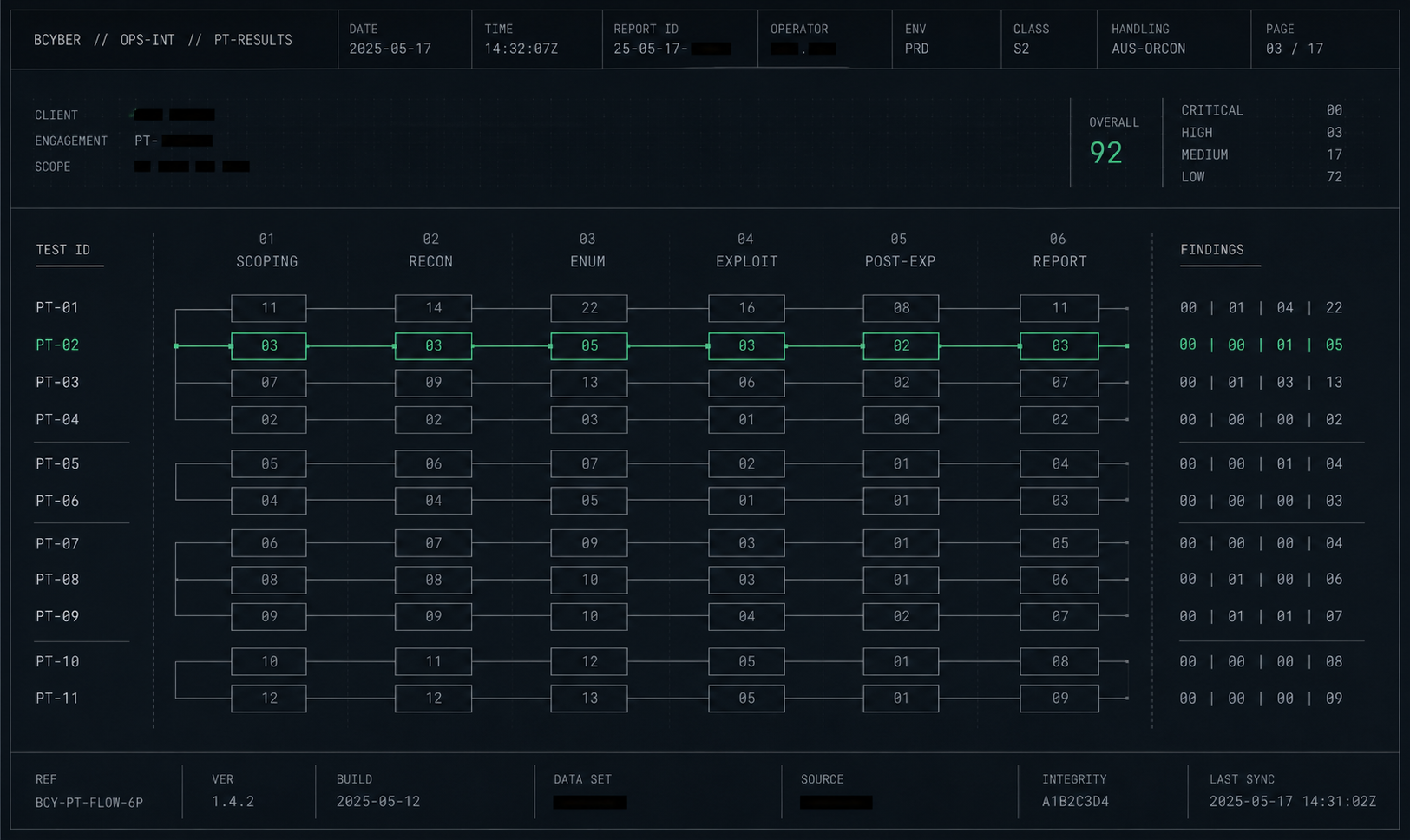
Penetration Testing Results: How to Turn Findings into Evidence, Remediation, and Real Security Improvements
By BCyber Security Team | CISSP, CISM Last updated: 29 September 2026

If you’ve just received a penetration test report and are asking, “What does this actually prove, and what do we do next?”, the answer is simple: treat the result as evidence, not a score.
A good penetration testing result shows what was tested, what was reached, what failed, how it was reproduced, and what remediation is now required. It does not certify security forever, and it does not become meaningful until someone owns the next control change. In practice, the report is only valuable when it helps security, engineering, and leadership make better decisions than they could have made without it.
At BCyber, this is how we structure assurance work across the GRACE Portal for executive visibility, Paradigm for control and policy automation, Profiler for behavioural risk analysis, and CyberTriage for rapid response validation. In engagements we support with clients across banking, healthcare, and government, we see the same pattern repeatedly: the organisations that improve fastest are the ones that turn pentest output into a managed remediation workflow, not a static PDF.
Verification note: BCyber platform and customer-count statistics referenced in this article are drawn from BCyber’s current internal platform inventory and published service ecosystem as of the last update date above. Where applicable, they should be validated against current internal records before external use.
What a penetration testing result actually proves
The result is evidence, not a trophy
A penetration testing result is the documented outcome of an authorised attempt to exploit vulnerabilities inside a defined scope, under agreed rules, at a point in time. That means the result is inherently bounded by what was tested, how it was tested, and what the tester was permitted to touch.
It can include successful exploitation, failed attempts, blocked paths, and situations where a control held up under pressure. The value is not in the label attached to the finding, but in the evidence that shows what an attacker could really do. If the result cannot be traced back to a specific attack path, a reproducible test, and a clear business impact, it is too thin to support remediation decisions.
A useful report answers practical questions that matter to the business and the technical team:
- What was in scope, what was excluded, and why?
- Which systems, accounts, APIs, or cloud services were reachable?
- What was the exact attack path, and where did defensive controls break down?
- Did the issue create confidentiality, integrity, or availability impact?
- What is the retest condition for closure?
Those details turn a vague vulnerability note into evidence of exposure, exploitability, or containment failure. In a mature program, the report becomes part of the organisation’s living knowledge base, so each finding strengthens the next round of defence rather than sitting untouched in a folder.
Why “passed” and “failed” are too blunt
It is tempting to read a pentest the way you would read an exam result, but that mindset hides more than it reveals. A “clean” or “low-risk” outcome only means the tested scope did not yield a demonstrable issue during that test window. It does not mean the environment is safe tomorrow, or that untested pathways do not exist.
A “high-risk” result also does not mean the whole environment is lost; it usually means a specific control failed in a way that materially increases risk. The difference matters, because one label invites complacency while the other can trigger panic.
This is where many organisations lose the real value of testing. They file the report as if the work is complete, when the report is actually the start of a control-improvement cycle. A result should provoke questions about reachability, privilege, containment, monitoring, and recovery. If the issue was exploitable, why was it exploitable? If the exploit was blocked, which control worked, and can it be strengthened? Those questions create a better security posture than any simple pass/fail banner ever could.
The evidence-based mindset that holds up under scrutiny
The strongest penetration testing results behave like assurance evidence. They show that a vulnerability existed, that it was reachable, that it could be exploited under the agreed conditions, and that the outcome mattered. They also show limits, because trustworthy evidence should say what was not proven as clearly as it says what was.
That distinction is especially important in Australian environments governed by APRA CPS 234, the Privacy Act 1988, and the ASD Essential Eight, where boards and risk owners need defensible evidence rather than confident claims. If a finding affected confidentiality, integrity, or availability, the report should make that visible without exaggeration.
For organisations operating under ISO/IEC 27001, this evidence also maps cleanly to control review, internal audit, and management review requirements. BCyber commonly uses the GRACE Portal to centralise the evidence trail across control findings, remediation status, and executive reporting, while Paradigm helps map issues to policies, compliance obligations, and control ownership.
A result without scope, proof, and retest criteria is only a finding summary.
A good result is useful to both engineers and executives because it can be read at two levels. Technical teams need reproduction steps, payloads, logs, and conditions. Leadership needs the business effect, the likely consequence, and the remediation priority. When both audiences can use the same evidence without re-interpreting it from scratch, the organisation moves faster. That is the difference between a report that informs action and a report that merely documents concern.
What scope and testing boundaries allow the result to mean
What was in scope determines what the result can say
The meaning of a pentest result depends on what was actually tested. Internal networks, web applications, cloud configurations, mobile applications, wireless access, identity systems, and social engineering exercises all produce different kinds of evidence. A result about an externally exposed admin portal is not the same as a result about east-west segmentation inside a cloud tenancy.
Likewise, a weakness found in one application does not automatically apply to every asset in the estate. Scope defines the boundary of truth, and everything outside that boundary stays unproven.
That is why explicit scoping matters so much. If the report lists applications, IP ranges, identities, tenants, or APIs, the reader can understand exactly where the evidence applies. If exclusions are also listed, the organisation can avoid overreading the results or assuming coverage that was never tested. In an Australian context, this also supports more defensible alignment with audit and compliance expectations, because the organisation can show what was examined, what was omitted, and why.
BCyber’s 23 policies, 9 processes, 50 courses, 951 published articles, 539 knowledge hub entries, 11 clients, and 14 fact-find assessments reflect a structured assurance environment where scope definition is not treated as a formality. It is managed as a control boundary. Where relevant, BCyber’s Policy Management, Compliance Mapping, and Executive Reporting capabilities in Paradigm help keep those boundaries visible to governance owners and delivery teams.
Constraints shape what can and cannot be proved
Testing rules matter as much as scope. Time windows, rate limits, safety constraints, legal boundaries, and tooling restrictions all influence the depth of the result. A test that prohibits destructive activity may still prove access, privilege escalation, or exposure without proving what happens under a full compromise scenario. That is not a weakness in the test design; it is a reflection of responsible testing.
The result should say what was attempted, what was observed, and what the constraints prevented the tester from doing. Those constraints also help explain why a result should not be misused. If the engagement was designed to validate external exposure, it should not be treated as evidence about internal resilience. If social engineering was out of scope, the absence of phishing impact tells you nothing about user susceptibility. If cloud administrative actions were restricted, a control might still be vulnerable in a different operating mode.
This is particularly relevant for healthcare providers subject to privacy obligations and for public sector teams managing sensitive citizen data. In those environments, a safe pentest may intentionally stop short of destructive actions, but it still provides valid assurance evidence if the path, impact, and control failure are documented properly. BCyber’s Privacy in Depth service is often used in parallel where test findings intersect with Australian Privacy Act obligations and personal information handling.
Objectives decide what “successful” really means
Every penetration test should have an objective, because the objective determines the meaning of success. Sometimes the goal is to validate exposure from the internet. Sometimes it is to simulate a real-world attacker, test segmentation, or confirm whether a privilege boundary can be crossed. In regulated environments, the objective may also support a formal control assessment or an audit evidence package.
The point is that a successful result is not always “we got admin”; sometimes it is “the control held, and here is the evidence showing where the boundary stopped the path.” This matters because a board member and an engineer may read the same result differently, yet both can be right. An engineer may focus on the exact misconfiguration or vulnerable dependency. A board member may focus on whether the issue could lead to reportable exposure, outage, or regulatory scrutiny.
The report should support both readings without confusing one for the other. When it does, the result becomes more than a technical artefact; it becomes part of the organisation’s operational memory.
How the attack path turns a finding into proof

Initial access shows where the door was open
The first important question is simple: how did the tester get in, if they did? Initial access might come from an exposed service, weak authentication, a misconfiguration, an application flaw, a trusted relationship, or a social engineering vector that was explicitly in scope. The entry point matters because it tells you whether the problem is at the perimeter, in identity, in application design, or in user behaviour.
A vulnerable login page suggests one remediation path; an exposed cloud management interface suggests another. The risk conversation changes depending on which door was open. A strong report does not just say “access gained.” It describes the circumstances that made access possible, whether the issue was repeatable, and what control should have stopped it. That control might be MFA, segmentation, strong session handling, patching, or secure configuration.
If the entry point was blocked by a compensating control, that control deserves attention too. A good pentest result therefore captures both weakness and resilience, which gives the organisation a more complete picture of how the environment behaves under pressure. BCyber’s Profiler can be particularly relevant here when the issue involves anomalous user behaviour, suspicious access patterns, or insider-risk indicators.
Privilege escalation and lateral movement reveal control failure
Once initial access is established, the next question is whether that foothold could expand. Privilege escalation might happen through credential reuse, misconfigured permissions, vulnerable components, weak service accounts, or insecure automation. Lateral movement might show whether segmentation, monitoring, or least privilege actually work in practice. This is where findings often become much more important, because a low-level compromise can become a high-impact event if internal controls are weak.
The report should show whether the path stayed contained or whether the environment allowed movement into systems of greater value. This is also where “bug” and “control failure” are not the same thing. A single vulnerability is one issue. A chain of issues that crosses privilege boundaries and reaches sensitive systems is a broader failure in defensive design. If the tester can move from one host to another, or from a user account to administrative control, the result proves that one or more barriers did not hold.
That evidence is materially more useful than a list of isolated CVEs, because it shows how an attacker would actually behave. In BCyber’s control ecosystem, this type of chaining is often mapped in GRACE for executive visibility, while response teams use CyberTriage to validate containment, triage speed, and escalation logic when the attack path resembles real incident conditions.
Data access tells you what the weakness means to the business
The most important part of the result is often what the tester could actually see or touch. Access to sensitive records, source code, secrets, cloud resources, or administrative controls changes the meaning of the finding immediately. It shows not just that a weakness exists, but that it can translate into confidentiality, integrity, or availability impact.
A report should describe this carefully and proportionately, without exposing unnecessary sensitive details in the document itself. The goal is to prove impact, not to create a second exposure through over-sharing. This is the point where business leaders often ask whether the result means a breach has occurred. Usually the answer is more precise: the result proves that the path to exposure existed under test conditions. It does not automatically prove persistent compromise, full environment takeover, or ongoing misuse.
Still, if the tester reached data or controls that should have been protected, that is enough to prioritise action. In practice, the organisation should treat the result as a proof point that the current control design did not hold the line as intended.
Practical sector examples
In financial services, we often see results where a misconfigured identity workflow lets a test account pivot into privileged functions in a staging environment that was too closely connected to production-adjacent services. Under APRA CPS 234 expectations, that becomes more than a technical defect: it is evidence that control assurance, privileged access review, and segmentation need attention.
In healthcare, a remote access portal or API exposure may reveal access to patient scheduling data, imaging metadata, or administrative consoles. Even when clinical systems are not fully compromised, the result can still indicate a privacy and confidentiality issue under the Australian Privacy Act and internal data-handling policy.
In government, a web application pentest may show that a low-privilege application account can enumerate internal endpoints or retrieve service secrets. For public-sector assurance teams, that often triggers a reassessment of network trust boundaries, logging, and incident detection.
These are not edge cases; they are the kinds of scenarios that turn a pentest from a technical exercise into a governance input.
Why evidence, reproduction, and validation matter
Evidence turns opinion into proof
Pentest findings become actionable when they are reproducible. Screenshots, request and response captures, logs, payloads, hashes, timestamps, and command output all help show that the result is real. Without that evidence, teams can spend days debating whether the issue was a false positive, a lab artefact, or a misunderstanding. With evidence, the conversation shifts from “did this happen?” to “how do we fix it?” That change saves time, reduces friction, and creates confidence in the remediation process.
The best evidence is minimal but sufficient. It proves the issue without dumping unnecessary secrets into the report. It also allows defenders to verify the result independently in a controlled environment. This is especially important when the finding is tied to privileged access, sensitive data, or cloud control planes. A report that balances proof with restraint is easier to share internally and easier to use in audit or governance discussions.
Reproduction steps help the fix land the first time
A result should include enough detail for engineering teams to reproduce the issue safely. That means prerequisites, affected versions, roles, conditions, and the exact sequence that led to the outcome. If the problem only appears in one configuration or under one user role, that should be explicit. Reproduction steps are not there to help an attacker; they are there to remove uncertainty from the fix process.
The clearer the path, the faster the team can verify the change and retest the control. This is where many remediation delays start. If the report says only “weak authentication” or “misconfiguration,” the fix may be guessed at instead of verified. If it explains the exact path, the team can change the right control, not just a nearby one. That matters because partial fixes often leave the core issue intact. In a living security program, clear reproduction steps are one of the best ways to help the knowledge base compound across teams.
BCyber’s 50 courses include role-relevant learning that can be aligned to remediation owners and technical teams, helping translate pentest output into action. Where appropriate, course pathways can reinforce secure configuration, policy adherence, incident response, and privacy handling.
Validation matters because false positives waste trust
A strong tester validates the result before reporting it. That means checking whether the issue is reproducible, whether it depends on a specific version or role, and whether the apparent impact is real. It also means being honest about edge cases and uncertainty. If a finding only appears under one configuration, the report should say so. If a control partially blocked the attack, that should be visible too. Trust grows when the report is precise about what was confirmed and what remains unknown.
The best reports do not pretend certainty where there is none. They say “TBD” when needed and let the evidence lead.
Validation is also important after remediation. A good retest does not simply confirm that the old exploit path is harder; it checks whether the control change actually removed the weakness or reduced it to an acceptable residual risk. If the tester cannot repeat the exploit under the same conditions, that is useful evidence. If the result only changes shape but remains exploitable, that is equally important. Either way, the organisation gets a clearer view of whether the fix worked.
How to convert findings into remediation and ongoing improvement
Ownership is the difference between a report and a change
Every finding should end with a named owner, not a generic “security team” note. Application teams may need to patch code, cloud teams may need to harden configuration, infrastructure teams may need to adjust segmentation, and IAM owners may need to redesign access control. If nobody owns the change, the finding becomes a document instead of an action. Ownership should sit where the control can actually be changed. That is how remediation becomes operational rather than symbolic.
This is also where the organisation needs to avoid treating security as a separate planet. Pentest results often expose shared responsibility across engineering, operations, and governance. A single issue may require a patch, a policy change, a monitoring update, and a training adjustment. When ownership is explicit, the work becomes easier to track and easier to close. When it is vague, the result tends to drift until the next audit reminds everyone it still exists.
Remediation should address root causes, not symptoms
The right fix depends on the nature of the finding. Vulnerable software needs patching or replacement. Unsafe configuration needs hardening and baselining. Weak authentication needs stronger identity controls, usually including MFA and better session management. Poor logging needs better telemetry and alerting. Architectural flaws may require redesign rather than patching, especially when the same weakness appears across multiple systems.
The important question is not “what is the quickest visible fix?” but “what change removes the underlying exposure?” A mature organisation uses this stage to improve more than one control at once. For example, if a tester reached a privileged admin surface, the fix may include MFA, network restriction, role review, and detection logic. That is not overkill; it is layered defence. A single change may close the exploit path, but layered improvements make recurrence less likely.
Retest criteria prove the improvement happened
A remediation task is not complete until the retest criteria are clear. Success should be defined in practical terms, such as the exploit path cannot be reproduced, the privilege boundary holds, the data is no longer accessible, or the control now blocks the specific sequence that previously succeeded. Vague statements like “looks fixed” do not give enough assurance. Objective retest criteria create a shared standard between the tester and the defender.
This is especially important where residual risk remains. Some findings may be mitigated rather than fully removed, and that is acceptable if the organisation understands the trade-off and documents the compensating controls. Those controls might include monitoring, WAF rules, additional segmentation, or tighter approval workflows. If risk acceptance is required, it should be explicit, time-bound where possible, and owned by the right decision-maker. That is how remediation stays honest rather than aspirational.

BCyber’s Perfect Storm can be used to model how control changes perform under compound threat scenarios, while TopSpin helps teams forecast the operational impact of unresolved risk trends over time. Together, these tools support a more realistic view of whether remediation is reducing risk or just moving it elsewhere.
How pentest results become part of a stronger security program
Different audiences need different views of the same evidence
A pentest result should be translated, not diluted. Leadership needs an executive view that explains risk, impact, urgency, and ownership in plain language. Engineers need the technical appendix with reproduction details, evidence, and fix guidance. Compliance and audit teams need to see how the result maps to control failures and how the organisation responded. The same evidence can support all three views if it is structured well. That structure is what turns a one-off report into a reusable asset.
This matters in Australian regulatory and governance settings, where evidence of control operation often needs to be understandable after the fact. APRA CPS 234, the Privacy Act 1988, the ASD Essential Eight, and ISO 27001-aligned control practices all benefit from clear traceability. If the organisation can show what was tested, what failed, what was fixed, and what was retested, the story becomes much stronger. The report then supports not just technical repair, but assurance and accountability.
Trends over time reveal the real health of the program
One pentest result is useful. A pattern of results is far more valuable. If the same type of weakness appears across multiple tests, that signals a systemic issue in design, patching, configuration, or governance. If the same team repeatedly remediates late, that may point to resourcing or workflow problems. If retests continue to find the same issue, the organisation may have a process problem rather than a technical one. Trend analysis helps security teams see whether the forest is actually growing healthier or simply being re-labeled.
This is where the most useful feedback loops start to appear. Findings can feed secure development standards, hardening baselines, detection engineering, and architecture review. Repeated attack paths can inform threat modelling and tabletop exercises. Results can also shape awareness training where user behaviour is part of the problem. Over time, the pentest stops being a discrete event and becomes one part of a self-improving security system.
BCyber’s GRACE Portal is designed for this kind of consolidation: single-dashboard visibility, cross-product analytics, executive reporting, compliance tracking, and real-time monitoring. In practice, that means one finding can be traced from test evidence through remediation ownership, policy alignment, and closure reporting.
The best programs measure closure, not noise
Useful metrics are simple and practical. Track how many findings were remediated, how long it took to remediate by severity, how many issues repeated in retest, and how many closures were validated rather than assumed. Those measures show whether the organisation is actually reducing risk or just producing paperwork. They also help leadership prioritise where to invest next. If the same class of issue keeps reappearing, the fix may need to be structural rather than tactical.
A programme that measures closure also tends to build better habits. Teams begin to expect evidence, ownership, and retest criteria as part of normal change management. That expectation improves delivery because security becomes a shared discipline rather than a late-stage review. In that sense, every good pentest result adds nutrients to the living system of the organisation. The immediate finding matters, but the lasting value comes from the change it creates in how the organisation thinks, proves, and improves.
BCyber platform alignment for pentest remediation and assurance
BCyber’s assurance model is built to support the full lifecycle of pentest results:
- GRACE Portal: centralised visibility for executive reporting, control status, and cross-product analytics
- Paradigm: policy automation, compliance mapping, and risk quantification for remediation governance
- Profiler: behavioural analysis for insider-risk, anomaly detection, and user activity patterns
- CyberTriage: rapid incident triage where pentest findings resemble real-world compromise indicators
- Perfect Storm: scenario modelling for resilience and compound-threat validation
- TopSpin: trend analysis and planning for capacity, performance, and risk forecasting
- Privacy in Depth: privacy controls and compliance support for regulated personal information environments
These capabilities are most useful when pentest outcomes must be aligned to internal policy, risk acceptance, or regulator-facing assurance. They also help teams avoid the common failure mode where findings are acknowledged but never operationalised.
Key Takeaways
Penetration testing results are most valuable when they are treated as evidence of what was actually reached, not as a pass/fail label. Scope, constraints, and objectives define what the result can honestly prove, so they should always be explicit. Reproduction steps, evidence, and validation turn findings into something engineering teams can fix with confidence. Remediation only becomes real when each issue has ownership, a root-cause fix, and objective retest criteria. The strongest programs then feed those results back into hardening, detection, and governance so every test improves the next one.
Sources and further reading
- APRA CPS 234 – Information Security
- ASD Essential Eight
- Australian Signals Directorate (ASD) – Strategies to Mitigate Cyber Security Incidents
- NIST SP 800-115 – Technical Guide to Information Security Testing and Assessment
- NIST Cybersecurity Framework (CSF)
- ISO/IEC 27001 overview
- Australian Privacy Act 1988
- ACSC – Essential Eight maturity model guidance
Industry recognition
BCyber and its leadership have been recognised in 2025 as:
- Finalist, Cybersecurity Professional of the Year — Karen Stephens, Co-Founder & CEO
- Finalist, GRC Provider of the Year
- Finalist, AI Innovator - Cyber Security
These recognitions are included here to provide additional context on BCyber’s current market presence and focus areas.


