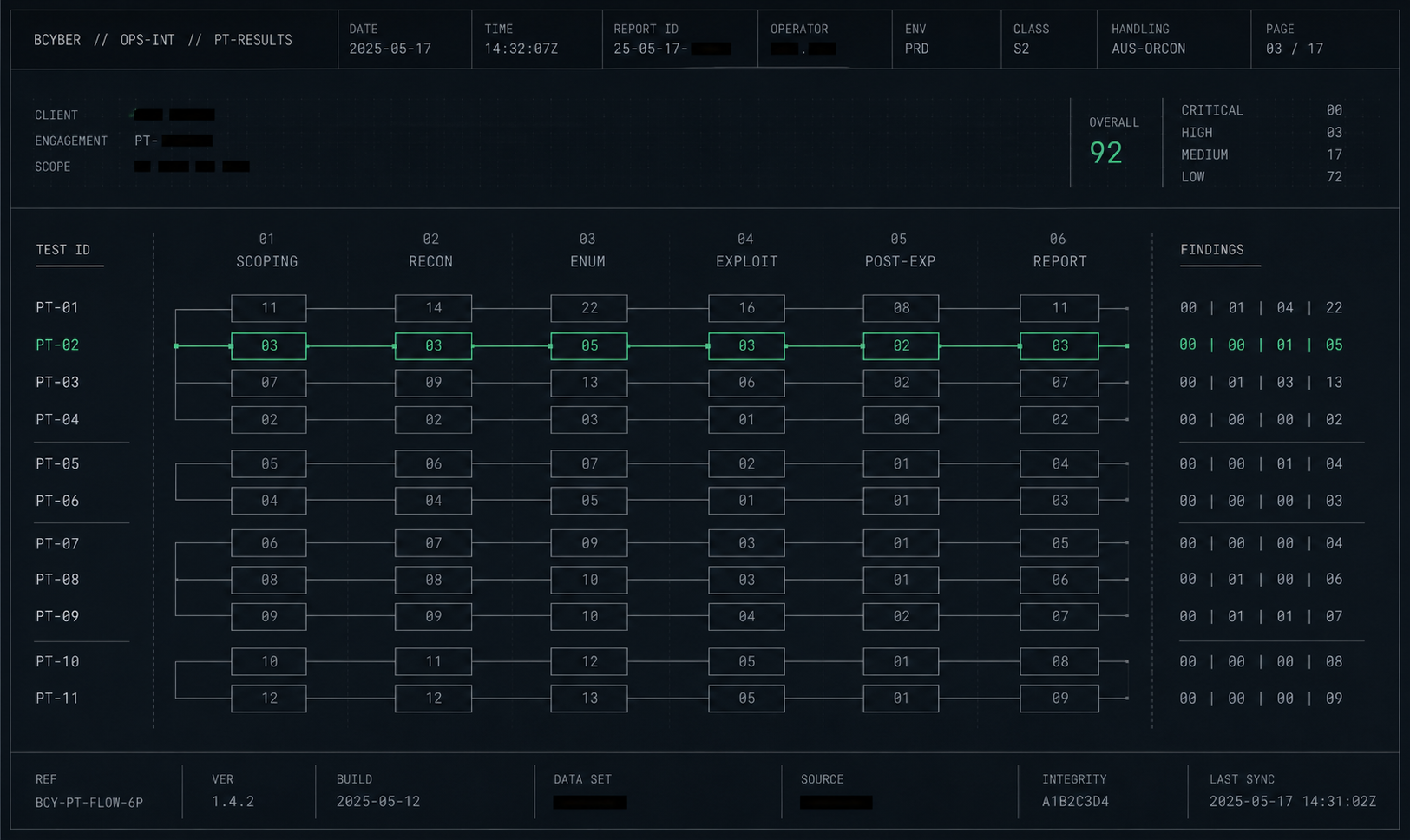
Penetration Testing Results: How to Turn Findings Into Actionable Security Intelligence

If you are asking, “We’ve got the pentest report — now what?”, the answer is simple: treat the results as evidence, not paperwork. Penetration testing results should tell you what was tested, what was proven, how it matters to your business, and what must change next. When they are handled well, they become operational intelligence for remediation, risk decisions, board reporting, and retesting. When they are filed away, they become a missed opportunity to strengthen control, accountability, and assurance.
What penetration testing results really tell you
The difference between a report and evidence
Penetration testing results are the documented outcomes of an authorised security test against a defined scope. They should show the target assets, the method used, the validation steps taken, and the impact demonstrated. In practice, that means a strong results package does more than list vulnerabilities; it explains whether the weakness was actually exploitable in your environment. It also shows whether the issue stood alone or formed part of a chained attack path. That distinction matters because a theoretical weakness and a proven exposure do not carry the same operational weight.
A useful way to read results is to ask three questions at once: what was found, what was proven, and what should happen next. If the report cannot answer all three, it is incomplete for decision-making. The best results packages include evidence that can be independently reviewed, such as screenshots, logs, commands, payloads, or safe proof-of-concept notes. They also separate observation from validation, so readers can see whether a finding is suspected, reproduced, or fully demonstrated. That clarity helps security teams avoid both overreaction and underreaction.
Why results matter to the wider security program
Penetration testing results should feed risk treatment, not just technical cleanup. In an Australian context, that makes them relevant to APRA CPS 234, the Essential Eight, the Privacy Act 1988, and sector-specific obligations such as Australian healthcare data protections. For regulated organisations, the evidence contained in the results can support control testing, due diligence, and board-level oversight. For less regulated organisations, the same evidence can still be used to prioritise remediation and strengthen internal assurance. The practical value is the same even if the regulatory lens changes.
Results also help mature the organisation’s view of exposure over time. One test gives a snapshot, but repeated testing can reveal recurring weaknesses in patching, identity control, cloud configuration, or application security. That is where the intelligence compounds. A single result should inform a ticket; a pattern of results should inform a control strategy. When that happens, testing becomes part of a living knowledge base rather than a one-off event.
A good penetration test result does not just name a weakness. It shows how a weakness became a business-relevant risk.
Why reports are often underused
Many organisations receive a polished PDF and then stop there. The report is archived, the project closes, and the findings slowly lose operational relevance. That happens because the report is treated as an endpoint rather than a working asset. It also happens when technical detail is not translated into business impact, so risk owners cannot easily decide what matters first. Without ownership, due dates, and retesting, even strong findings drift into administrative silence.
There is also a structural problem in how some reports are written. If the document is too generic, it cannot guide remediation in the actual environment. If it is too technical without context, board members and risk teams may not know how to use it. If it is too severe without evidence, engineers may not trust it. The best results packages avoid those traps by balancing reproduction detail with decision-ready context. That balance is what turns a static document into security intelligence.

What should be inside a strong results package
Scope, authorisation, and testing conditions
A high-quality penetration testing results package begins with scope. It should clearly identify the assets, environments, accounts, exclusions, and assumptions used during the assessment. It should also state whether the testing was internal, external, authenticated, unauthenticated, or based on an assumed breach model. Without that context, readers cannot judge what the results actually represent. Scope is not administrative detail; it is the frame that determines the meaning of the findings.
Authorisation and dates matter for the same reason. The report should show when testing occurred, how long it ran, and who approved it. This is especially important when results are used in governance, audit, or risk acceptance discussions. An issue found months ago may no longer exist, and a remediation claim made today may not reflect the tested state. Clear dates let the reader anchor the evidence properly.
Methodology, rules of engagement, and safety limits
The methodology section should explain how the test was conducted and what standards or techniques shaped the approach. It should also set out limits on exploitation, social engineering, denial-of-service activity, or lateral movement where those actions were excluded. This is not filler. It tells the reader what the tester was allowed to prove and what was intentionally left untouched. That distinction protects both the test and the integrity of the results.
Rules of engagement are especially important when results are later used to challenge assumptions. If the tester was not allowed to trigger disruptive actions, then a lack of impact evidence may reflect a safety boundary rather than an absence of risk. If social engineering was excluded, then human control weaknesses may remain untested. A good report states those limits plainly, so no one mistakes restraint for control strength. That honesty increases trust in the findings that were actually demonstrated.
Findings, validation, and exploitation narrative
Each finding should be described consistently, with the condition observed, the path to validation, the evidence collected, and the impact shown. Strong reporting distinguishes between what was discovered through scanning or observation and what was actively proven. If a finding could be chained with another weakness, the report should show that chain rather than bury it in a footnote. Real risk often emerges from sequences, not isolated defects. A results package that captures this properly is far more useful to remediation teams.
Validation evidence should be reproducible where safely possible. That does not mean handing over harmful instructions. It means showing enough detail that another qualified practitioner could verify the issue, at least within a controlled environment. Screenshots alone are often not enough unless they are paired with explanatory context. Likewise, commands or payloads without interpretation can be hard to trust. The strongest reports connect the dots between evidence, exploitability, and outcome.
Risk rating and business context
Technical severity is only part of the story. A finding becomes operationally important when it is viewed alongside asset criticality, data sensitivity, internet exposure, and compensating controls. A medium issue on a critical payment or patient-facing system may deserve more attention than a high issue on a low-value test asset. That is why business context must sit beside technical scoring. Without it, prioritisation becomes guesswork dressed up as process.
A useful report explains the consequences in language that risk owners can use. That may include data access, service disruption, privilege escalation, or trust boundary compromise. It may also explain whether the issue supports a broader attack path. The goal is not drama; it is clarity. If leadership can understand the operational consequence, they can make better decisions about urgency, funding, and acceptance.
Remediation guidance that can actually be used
Good remediation advice is specific, feasible, and tied to the finding. “Patch systems” is usually too vague to help. A stronger recommendation identifies the root cause, the control gap, and the practical fix path. It may include configuration changes, code changes, compensating controls, or segmentation steps, depending on the issue. Where there are trade-offs, the report should say so.
The remediation section should also define what success looks like during retesting. That might mean a service no longer responds in a vulnerable way, a misconfiguration has been corrected, or a control now blocks the attack path. Clear closure criteria reduce arguments later. They also help teams avoid the trap of implementation claims without proof. In a mature process, remediation is not complete until the fix is validated.
How to interpret findings without missing the point
Severity is not the same as priority
Severity describes the technical nature of the issue. Priority reflects what should be fixed first in your environment. Those two ideas often overlap, but they are not identical. A high-severity finding on a non-critical system may wait behind a medium-severity issue on a sensitive, business-critical asset. If the report does not help you separate those concepts, it is not yet decision-ready.
The practical test is simple: ask how easily the issue could be exploited, what access it might expose, and what it touches if abused. Also ask what compensating controls already exist. A finding behind strong identity controls, limited exposure, and good monitoring may be less urgent than one sitting directly on an externally reachable path. That does not make it harmless. It means prioritisation should follow context, not labels alone.
Chains of weakness often matter more than individual items
Many of the most important findings are not dramatic in isolation. They become serious when linked together. For example, a low-value information disclosure may help identify a service. That service may then reveal a privilege escalation path or a weak trust boundary. On their own, each issue may look manageable. Together, they can form a meaningful attack path.
This is where good results make a real difference. A report that shows the chain lets the organisation see the actual route an adversary could take. That is much more useful than a spreadsheet of unrelated defects. It also supports better remediation planning, because teams can see which root causes sit behind several symptoms. Fixing those root causes first often delivers better risk reduction than chasing every item individually.
Evidence quality changes confidence
Not all findings deserve the same level of trust. Strong evidence includes clear reproduction steps, contextual detail, and proof that the issue was validated in the tested environment. Weak evidence may be ambiguous, incomplete, or too generic to support action. If the report cannot be followed by a qualified team member, the organisation may spend time on the wrong problem. That is why evidence quality is part of the result itself.
Confidence matters for triage. Overstated findings can create unnecessary urgency and erode trust. Understated findings can delay important fixes. The organisation needs enough evidence to decide what to do, but not so much noise that the signal disappears. That balance is one of the clearest markers of a mature testing program.
The most useful result is not the loudest one. It is the one that can be validated, prioritised, and acted on without ambiguity.

How to turn results into remediation and governance
Building a remediation workflow that survives reality
A penetration test only creates value when its findings enter a working process. That means each finding should become a tracked item with an owner, a due date, and a status that can be reviewed. Related items should be grouped where that reduces friction, especially when multiple findings share the same root cause. This is where security teams, infrastructure owners, application teams, and risk managers must stay connected. If the workflow breaks at handover, the test becomes a memory exercise instead of an improvement mechanism.
It helps to distinguish between fix streams and exceptions. Some findings can be resolved quickly through patching or configuration change. Others require architecture decisions, vendor input, or change windows. That difference should be visible in the remediation plan. Clear ownership reduces the chance that important issues are assumed to be “someone else’s problem”.
Retesting and closure evidence
Retesting is the step that turns a claimed fix into a validated one. Without it, the organisation may close issues that still exist or mark risk as reduced when it is merely postponed. The retest should check the original condition, confirm the fix, and capture before-and-after evidence. That creates a defensible record for audit, assurance, and internal governance. It also improves confidence in the team’s remediation discipline.
Closure should be based on proof, not promises. If the finding is no longer exploitable, the report should show that the path has been removed or blocked. If a compensating control is used instead of a direct fix, that should be documented alongside the residual risk. This is especially important in environments governed by APRA CPS 234 or board reporting expectations, where evidence of ongoing control effectiveness matters. Retesting is not bureaucracy; it is verification.
Risk acceptance and exceptions
Not every finding can be fixed immediately. Business constraints, legacy dependencies, vendor limitations, and release timing all shape what is possible. In those cases, formal risk acceptance may be appropriate. But acceptance should never be casual. It should be time-bound, approved by the right owner, and supported by compensating controls where available.
The acceptance record should also state when the issue will be reviewed again. That prevents indefinite deferral from masquerading as governance. A clear exception process is a sign of maturity because it acknowledges that some risks are managed rather than eliminated. The important thing is that the organisation knows what it is accepting, why, and for how long.
Using results in board and executive reporting
Board reporting should not reproduce the whole technical report. It should translate findings into exposure, trend, and decision points. The most useful summaries show where risk is concentrated, what kinds of issues recur, and whether remediation is moving at the right pace. They may also include attack-path summaries or simple visuals that show how a finding affects a business service. The aim is to support oversight, not to drown the board in detail.
Executive reporting works best when it answers three questions: what changed, why it matters, and what is being done. That framing keeps the conversation practical. It also helps security teams communicate without losing technical accuracy. When findings are linked to business services and owner accountability, reporting becomes easier to act on. It stops being a recap and becomes a management tool.
Where penetration testing results often lose value
Static PDFs with no operational follow-through
The most common failure mode is simple: the report is delivered, read once, and then forgotten. Findings remain unresolved because no process captures them into work queues. That means the organisation paid for evidence but not for improvement. The problem is not the test itself; it is the lack of integration. Results should flow into vulnerability management, risk registers, and remediation tracking.
A static report also makes learning hard. If each assessment starts from scratch, the organisation cannot easily compare patterns across time. That prevents the security program from compounding knowledge. A living approach, by contrast, lets each test improve the next one. Over time, the knowledge base grows like a forest: roots deepen, paths connect, and the whole ecosystem becomes more resilient.
Missing context and generic remediation advice
A finding without context is easy to misread. Teams may spend too long on low-value items or overlook issues that affect critical services. The same problem appears when remediation advice is too generic to help the environment in front of them. If the report does not explain where the issue sits, who owns it, and what it could affect, the finding loses half its value. Good context turns a technical issue into a management decision.
Inconsistent scoring and closure standards
If every test uses a different scoring approach, trend analysis becomes unreliable. A “high” from one provider may not mean the same thing as a “high” from another. The same problem appears when one team closes issues on implementation claims while another demands evidence of fix. Consistency matters because security programs rely on comparison over time. Standardised criteria make the results easier to trust and easier to use.
How to get more value from future testing cycles
Define the purpose before the test begins
Before testing starts, stakeholders should agree on what the results are meant to support. Is the goal remediation, control validation, board assurance, regulatory evidence, or all of these? The answer influences scope, depth, and reporting format. If the purpose is unclear, the report will likely be too. A well-defined purpose is the simplest way to improve usefulness.
Standardise result formats and link them to assets
Using consistent templates makes results easier to compare and easier to action. Findings should map to business services, data classes, and system owners wherever possible. That connection helps security teams prioritise by relevance rather than by volume. It also makes reporting more meaningful to non-technical stakeholders. Standardisation reduces friction and improves the chance that findings are acted on quickly.
Feed the results into a continuous assurance cycle
The real gain comes when penetration testing results are part of a recurring cycle of test, fix, verify, and learn. Patterns across multiple assessments can reveal recurring weaknesses in identity, configuration, patching, or architecture. Those patterns should inform training, control design, and investment decisions. This is where operative intelligence starts to compound. The organisation is no longer renting insight for one report cycle; it is building its own memory.
Key Takeaways
Penetration testing results are most useful when they are treated as evidence for action, not as a final document to archive. They should show what was tested, what was proven, and what should happen next in a way that supports technical, operational, and board-level decisions. The strongest results packages include scope, authorisation, methodology, validation evidence, business context, and practical remediation guidance. They also state their limits clearly, so no one confuses a safe test boundary with a clean bill of health.
Results create the most value when they feed remediation workflows, retesting, risk acceptance, and executive reporting. They should be translated into business impact, not just technical detail. They should also be standardised enough to compare over time, but specific enough to guide action in the actual environment. If you hold penetration test results that are not changing priorities, assignments, or closures, the problem is not the evidence itself. The problem is that the evidence is not yet part of a living security system.