Board Cyber Risk Reporting: How Directors Can See, Measure, and Act on Cyber Risk
By BCyber Security Team | CISSP, CISM Last updated: 8 October 2026

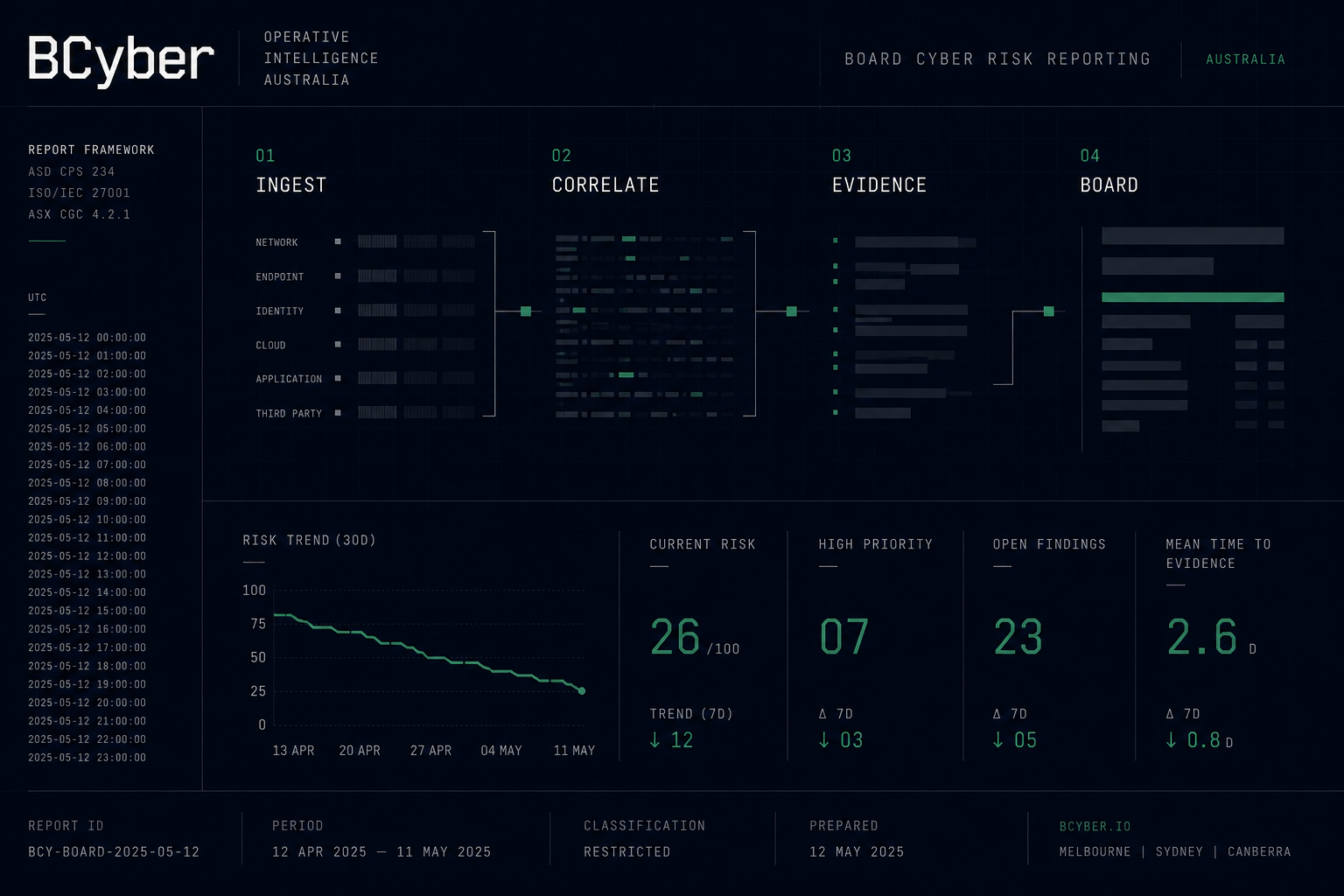
Board cyber risk reporting works best when it helps directors make decisions, not decode jargon. In practice, that means translating technical detail into material business impact: which risks are most significant, whether controls are actually working, what has changed since the last meeting, and what the board needs to approve, challenge, or escalate.
This article draws on BCyber’s internal platform experience across 23 policies, 9 processes, 50 courses, 974 published articles, 563 knowledge hub entries, 11 clients, and 14 fact-find assessments. The examples and reporting patterns below are based on recurring governance themes seen across financial services, healthcare, and government-style environments. Where statistics are mentioned, they are presented as platform-derived observations and should be validated against the reader’s own environment, risk appetite, and control evidence.
Why board cyber risk reporting now sits inside enterprise risk
Cyber risk is no longer an isolated IT concern. A serious incident can disrupt revenue, trigger regulatory reporting, affect customer trust, and create operational continuity issues at the same time. For Australian organisations, that shift is reinforced by regulatory expectations and assurance obligations that increasingly treat cyber as a board-level risk.
For example:
- APRA CPS 234 expects regulated entities to maintain information security capability commensurate with the threats and vulnerabilities they face, and to test controls regularly.
- Where applicable, APRA CPS 230 raises the bar on operational resilience and service continuity, making cyber and continuity reporting more closely linked.
- The Essential Eight remains a practical baseline for reducing common attack paths such as phishing, credential theft, and ransomware.
- The Privacy Act 1988 and OAIC expectations mean cyber incidents can quickly become privacy, legal, and reputational events.
A board does not need packet captures, SIEM query syntax, or vulnerability export files. It needs a decision-ready view of exposure, control performance, and residual risk. That is why board reporting should focus on what could materially harm the organisation, how likely that harm is, and whether the current controls reduce the risk to an acceptable level.
What a board-grade report must answer
A useful report should stand on its own, even if a director only reads the executive summary. It should answer four questions:
- What are our most material cyber risks right now?
- Are the controls working, and what evidence supports that view?
- What incidents, near misses, or trends have changed the risk picture?
- What decision, funding, or direction do you need from the board?
If the report cannot support a decision, it is not yet board-grade.
That structure is consistent with good enterprise risk governance and aligns naturally to BCyber’s GRACE Portal, which provides a unified dashboard for executive reporting, compliance tracking, real-time monitoring, and cross-product analytics. In practice, this kind of centralised reporting helps connect technical evidence from tools and operations to board-level oversight.
What directors actually need to see in a cyber risk report
Board reporting works best when it compresses complexity without hiding it. Directors do not need every alert or ticket, but they do need enough evidence to judge whether the organisation is improving, stagnating, or drifting into exposure. The strongest reports use plain language and tie every metric to a business consequence.
A report is more useful when it moves beyond “activity” and into “effectiveness.” For example, it is not enough to say patching is happening. The board needs to know whether critical vulnerabilities are being remediated within target timeframes, whether exceptions are approved and tracked, and whether the residual exposure matches risk appetite.
The four questions behind every board pack
A practical board pack usually centres on four sections:
- Top risks by business impact and likelihood
- Control effectiveness with evidence
- Material incidents and emerging trends
- Board decisions required
A common weakness is the use of broad labels such as “green,” “amber,” or “red” without enough context to justify them. If a risk is marked acceptable, the report should show the residual risk, the control evidence, and the approval authority. If a risk is tolerated temporarily, the report should show the expiry date, the owner, and the compensating controls.
The reporting components that matter most
A board-grade report usually includes:
- An executive summary of the current cyber posture and the biggest changes since the last report
- A top-risk register or heatmap with business impact, owner, control status, and residual risk
- Control effectiveness metrics for core safeguards such as MFA, patching, endpoint protection, backups, and incident response
- Incident and trend reporting covering material events, root causes, near misses, and threat patterns
- An action tracker with owners, due dates, status, and escalation points
BCyber teams often map these components into Paradigm for GRC automation, policy mapping, and compliance tracking; Profiler for behavioural risk analysis and insider-threat indicators; and CyberTriage for rapid containment and 4-minute triage workflows. Where boards want a forward-looking view, Perfect Storm scenario modelling can be used to show how compound threats could affect operations, while TopSpin can support trend analysis and capacity planning where resilience depends on storage, retention, and recovery performance.
Consistency matters. If the report format changes every quarter, directors lose trend visibility. Stable reporting also supports auditability, which becomes important when management needs to justify why a given risk rating was reasonable at the time it was made.
Which metrics deserve a place in front of the board?
The best board metrics answer one question: “So what?” Metrics that reflect effort alone can be misleading because they may show activity without proving risk reduction.
For example, a report can say many vulnerabilities were scanned, many awareness modules were sent, or many policies were updated. None of that tells directors whether the organisation is harder to compromise today than it was last month.
Metrics that signal exposure, resilience, and recovery
Board-relevant metrics usually sit in four categories:
- Exposure metrics: MFA coverage, privileged access reviews, critical vulnerability ageing, attack surface exposure
- Resilience metrics: backup restore success, recovery point objective attainment, disaster recovery test results
- Detection and response metrics: mean time to detect, mean time to contain, mean time to recover
- Assurance metrics: third-party assessments, control test completion, policy compliance, exception ageing
A report becomes more useful when each metric is paired with a trend line. A single point-in-time value can be reassuring or alarming without context, but a trend reveals direction. If MFA coverage has stalled or patching time is lengthening, the board can see where the system is drifting. If backup tests are failing more often, or restore times are deteriorating, directors should ask whether the issue is resourcing, process design, or architecture.
BCyber’s 50 courses and 2 enrollments in the platform inventory should not be interpreted as maturity on their own; training activity only matters if it changes control behaviour. For that reason, board packs should connect awareness completion to phishing susceptibility, privileged access hygiene, and incident reporting quality.
A practical metric set directors can understand
| Metric | Why it matters to the board | What to ask | |---|---|---| | Critical assets protected by MFA | Reduces account compromise exposure | Which systems are still excluded, and why? | | Critical vulnerabilities older than target threshold | Shows patching discipline and exposure window | What is the remediation bottleneck? | | Backup restore success rate | Indicates recoverability after ransomware or failure | When was restore testing last validated? | | Mean time to detect/respond | Signals the speed of containment | Are trends improving or worsening? | | Privileged accounts reviewed | Reduces misuse and stale access risk | Who approves exceptions and for how long? | | Third-party assessments completed | Shows supply chain oversight | Which critical suppliers remain unassessed? |
Boards should resist the temptation to load the report with dozens of indicators. Six well-chosen metrics usually tell a clearer story than twenty loosely connected ones. The goal is not a perfect scorecard; it is a truthful one.
Where board reports usually go wrong, and how to fix them
The most common reporting failure is misalignment. Security teams often prepare reports for technical peers, while boards need a business narrative with evidence behind it. That mismatch produces pages full of tooling language, vulnerability counts, or control descriptions that do not translate into decisions.
The traps that hide material risk
One trap is too much technical detail. Directors rarely need configuration-level data unless a specific setting changes business exposure or informs a decision. Another trap is weak linkage to business impact, where a cyber issue is described but not connected to operations, financial effect, legal consequence, or safety. A third trap is overconfidence, where a control is described as effective simply because it exists rather than because it has been tested. A fourth trap is the absence of ownership, where risks are acknowledged but no one is clearly accountable for closing the gap.
These traps can make a report look mature while unresolved issues remain hidden. A polished dashboard can obscure untested controls just as easily as a sparse report can obscure underinvestment. Directors should therefore look for evidence, not presentation quality.
Questions that create constructive doubt
Boards can improve oversight by asking:
- What changed since the last report, and why did it change?
- Which risks could cause material harm if realised?
- How do we know the control actually works, not just that it exists?
- Are we underestimating recovery, supplier, or identity risk?
- Which issue needs a board decision now, rather than later?
Those questions force the discussion away from generic assurance and toward material judgement. They also surface whether management is reporting facts, assumptions, or aspirations.
How organisations can make reporting more decision-ready
The strongest board reporting is not assembled at the end of the quarter like a slide deck rescue mission. It is built from a repeatable operating rhythm where evidence is collected, tested, and reviewed continuously.
Practices that make reporting clearer and more useful
A strong reporting model usually follows a few simple disciplines:
- Keep the report format stable so trends are visible.
- Tie every metric to an outcome or risk statement.
- Pair numbers with plain-language explanation.
- Escalate material issues as soon as they emerge.
- Record owners, due dates, and status for every significant action.
These practices do not require exotic tooling. They require clarity about what the board needs to govern, and restraint about what the board does not need. A report should be written for decision-making, not display.
How cyber fits into broader governance
Cyber should not sit in isolation from operational, legal, and strategic reporting. It belongs in the same governance fabric as resilience, third-party risk, privacy, and business continuity.
That is particularly relevant in sectors where controls are already mature but expectations continue to rise:
- Financial services: A APRA-regulated entity may need to show how identity controls, privileged access review, and backup recoverability align to CPS 234 and operational resilience expectations.
- Healthcare: A privacy incident can quickly become a clinical continuity issue if critical systems are unavailable or records are delayed.
- Government: Service availability and data handling obligations often create stronger expectations around assurance, incident response, and supplier control.
BCyber’s Privacy in Depth capability supports privacy management for Australian privacy obligations, while GRACE Portal can consolidate evidence from policies, controls, reporting, and compliance mapping into a single executive view.
What a mature board conversation sounds like
A mature board conversation about cyber risk does not sound like a technology briefing. It sounds like a governance conversation grounded in evidence. Directors ask what changed, what matters, what is still unknown, and what decision is required. Management responds with context, trend data, and clear ownership.
Practical examples by sector
Financial services example: A board pack shows that critical vulnerabilities on internet-facing systems have improved, but privileged account reviews for a key third party are overdue. Under APRA CPS 234, the board should ask whether third-party assurance is sufficient and whether compensating controls exist. If the organisation relies on a vendor-managed identity platform, the board should ask how logging, segregation of duties, and access recertification are being validated.
Healthcare example: A hospital reports that endpoint protection is broadly deployed, but backup restore tests are failing for a clinical imaging environment. The board should focus on recoverability, downtime tolerance, and patient safety impact rather than software licensing status. In this case, the right question is not “are we compliant?” but “can clinicians safely continue if the primary environment is unavailable?”
Government example: A department shows good policy coverage but poor exception discipline for legacy systems. The board or executive steering committee should ask whether the residual risk is documented, whether compensating controls meet the intent of the Essential Eight, and whether the decommissioning timeline is realistic.
How BCyber products support the governance conversation
The BCyber CyberSuite can help turn governance into a connected reporting system:
- GRACE Portal — unified executive visibility, cross-product analytics, reporting, and compliance tracking
- Paradigm — AI self-learning GRC automation, policy mapping, and risk quantification
- Profiler — behavioural intelligence for insider threats, access anomalies, and user activity analytics
- CyberTriage — AI-powered incident response with 4-minute triage to support rapid containment
- Perfect Storm — scenario intelligence for threat simulation and resilience testing
- TopSpin — analytics for forecasting, capacity planning, and performance monitoring
- Privacy in Depth — privacy management aligned to Australian privacy obligations
Where boards need to understand the implications of a cyber event, these tools are most effective when integrated into a single reporting rhythm rather than used as disconnected point solutions.
Sources and frameworks directors should recognise
Board reporting becomes more credible when it is anchored in recognised standards and public guidance. The most commonly referenced sources in Australian cyber governance include:
- APRA CPS 234 – Information Security
- APRA CPS 230 – Operational Risk Management
- ACSC Essential Eight – baseline mitigation strategies
- ASD/ACSC Guidelines for System Hardening and cyber mitigation guidance
- NIST Cybersecurity Framework (CSF 2.0) – governance, identify, protect, detect, respond, recover
- NIST SP 800-53 – security and privacy controls
- ISO/IEC 27001:2022 – ISMS requirements and control management
- OAIC Notifiable Data Breaches guidance – breach assessment and notification considerations
Useful references:
- APRA: https://www.apra.gov.au/cps-234-information-security
- APRA: https://www.apra.gov.au/cps-230-operational-risk-management
- ACSC Essential Eight: https://www.cyber.gov.au/resources-business-and-government/essential-cyber-security/essential-eight
- ACSC guidance: https://www.cyber.gov.au
- NIST CSF 2.0: https://www.nist.gov/cyberframework
- NIST SP 800-53: https://csrc.nist.gov/publications/detail/sp/800-53/rev-5/final
- ISO/IEC 27001 overview: https://www.iso.org/isoiec-27001-information-security.html
- OAIC NDB scheme: https://www.oaic.gov.au/privacy/notifiable-data-breaches
How BCyber applies governance evidence in practice
BCyber’s platform inventory includes 23 policies and 9 processes, which are used to structure evidence collection, control accountability, and reporting consistency. The platform also includes 974 published articles and 563 knowledge hub entries, which support internal guidance, control interpretation, and operational learning. Across 11 clients and 14 fact-find assessments, the recurring pattern is the same: board reporting improves when evidence is structured around risk decisions rather than technical output.
BCyber’s recent recognition includes:
- 2025 Finalist Cybersecurity Professional Of The Year — Karen Stephens, Co-Founder & CEO
- 2025 GRC Provider of the Year — Finalist
- 2025 AI Innovator - Cyber Security — Finalist
These acknowledgements are relevant because they reflect external market recognition in governance and AI-enabled security, not just product messaging. Still, readers should evaluate any vendor, including BCyber, on the strength of its evidence, the relevance of its controls, and how well its outputs align to the organisation’s own regulatory and operational context.
A practical board checklist
Before the next board meeting, directors should be able to answer the following:
- Do we know our top three cyber risks in business terms?
- Can management show evidence that the key controls are working?
- Are our exceptions, tolerances, and compensating controls clearly owned and time-bound?
- Are incidents and near misses changing our risk picture?
- Do we know which decisions the board must make now?
- Are our reporting metrics tied to resilience, not just activity?
If the answer to any of these is unclear, the report is not yet fit for purpose.
Conclusion
Board cyber risk reporting is valuable only when it helps directors see material risk clearly, measure whether controls are working, and act on what matters most. The strongest reports are concise, evidence-based, and tied to business impact rather than technical volume. They show what changed, why it matters, who owns the next step, and what decision the board needs to make.
In an Australian governance environment shaped by APRA CPS 234, the Essential Eight, privacy obligations, and increasing expectations around resilience, that level of clarity is not optional. It is how directors discharge oversight responsibly. The good news is that board-grade reporting is not built from more noise; it is built from sharper questions, better evidence, and a stable operating rhythm that makes risk visible.
Verification note: BCyber platform figures, product capabilities, and client/assessment counts cited in this article are based on internal platform data supplied for editorial use and should be independently validated before external assurance or regulatory submission.
Key Takeaways
- Board cyber risk reporting should focus on material risk, control effectiveness, incidents, trends, and decisions, not technical volume.
- Directors need evidence-based reporting that connects cyber issues to business impact, regulatory expectations, and operational resilience.
- A stable report structure makes it easier to compare trends, challenge assumptions, and track remediation over time.
- The most useful metrics are the ones that show exposure, resilience, detection, response, and recovery.
- Strong oversight comes from specific questions, clear ownership, and honest reporting about what is known and what remains uncertain.


