CISO Strategy and Leadership in Practice: Building Governance, Trust, and Measurable Security Outcomes
By BCyber Security Team | CISSP, CISM Last updated: 26 October 2026

If you are asking, “what does a CISO actually need to do beyond running security tools?”, the answer is this: set direction, prove control, and keep the organisation improving. CISO strategy and leadership is the discipline of turning cyber risk into governed decisions, funded priorities, accountable execution, and evidence the board can trust. In practice, it spans governance, risk, assurance, incident readiness, culture, and regulatory alignment — not just technology.
For regulated Australian organisations, that means the CISO role must work across APRA CPS 234, the Privacy Act 1988, the Australian Privacy Principles (APPs), and the Essential Eight where relevant. In many cases, it also requires alignment to ISO/IEC 27001 and NIST CSF 2.0 to give the business a common control language across risk, operations, and audit. The role is broader than security operations because it sits where resilience, regulatory duty, and business continuity meet.
Why CISO leadership matters when cyber risk becomes a business issue
Many organisations still treat cybersecurity as a tooling problem, as though more alerts, more dashboards, and more products will somehow create resilience on their own. That approach can leave critical gaps untouched because the real issue is often not the absence of tools, but the absence of decision-making structure.
A mature CISO strategy answers not only what to protect, but how to fund it, govern it, and sustain it over time. When leadership is missing, security work tends to become fragmented, reactive, and difficult to explain to executives. When leadership is present, the security function becomes easier to trust because it shows its reasoning, not just its output.
For this case study, imagine a mid-sized Australian financial services organisation with cloud-hosted customer systems, outsourced payroll, a hybrid identity environment, and growing pressure from board, audit, and regulators. Similar patterns appear in healthcare and government as well: patient records, citizen data, and identity services often span multiple systems and providers, making clear accountability difficult without a formal governance model.
The challenge was not simply technical weakness; it was the absence of a shared model for prioritising risk. In that environment, security can start to look like a cost centre because the organisation cannot see how the work connects to continuity, compliance, and trust. That is the point where CISO leadership matters most.
A useful way to frame this is to ask: who is actually making the cyber decisions in the business, and on what evidence? If the answer is “the loudest incident, the latest audit finding, or the vendor tool that generated the most alerts,” then security is being driven by noise rather than strategy.
Under APRA CPS 234, entities within scope must maintain information security capability commensurate with the size and extent of threats, implement controls to protect information assets, and test those controls regularly. The same logic echoes through the Privacy Act 1988, the APPs, and the Essential Eight. The organisation does not need more theatre; it needs a way to see risk, decide on it, and prove what changed.
A strong CISO does not just defend systems. They help the organisation decide what matters, what can wait, and what evidence will stand up to scrutiny.
What was broken before the strategy changed?
The first sign of immaturity was not a major breach. It was drift.
Security effort was spread across teams, priorities were set by urgent alerts, and the same categories of issues kept reappearing in different forms. Asset visibility was incomplete, which meant the team could not always say which systems were business critical, which dependencies were hidden, or which controls were missing on the services that mattered most.
Board reporting existed, but it was too technical in some places and too generic in others, so executives could not easily tell what was improving and what was merely being documented. That is a common failure mode in organisations that have grown quickly or acquired services without integrating governance.
In one scenario, a healthcare provider might know that clinical records are protected, but not have a reliable picture of which downstream systems sync copies to external platforms, who can access those records via service accounts, and whether MFA and logging are consistently enforced. In government, the same problem often appears when citizen-facing portals are supported by multiple vendors, each with different patching and logging maturity. In financial services, the issue may present as untested disaster recovery for core payments or authentication platforms.
That combination creates practical business risk. High-priority vulnerabilities can remain open because no one has clear ownership. Third-party exposure is discussed, but not consistently mapped to operational consequences. Incident readiness exists as a concept, but it has not been tested enough to give leaders confidence in the organisation’s response and recovery.
This is where BCyber’s governance and assurance stack becomes relevant. A program built around the GRACE Portal gives executives a single dashboard for cross-product analytics, executive reporting, compliance tracking, and real-time monitoring. That matters because governance fails when information is fragmented across tools and teams. The organisation in this case study needed a central view before it could make reliable decisions.
The leadership problem showed up in funding conversations too. Security initiatives that should have been discussed as resilience investments were often framed as technical maintenance, which made them easier to defer. Without a risk-based narrative, it was hard to show why identity hardening, logging improvements, or backup testing should sit ahead of more visible but less material work.
How did the CISO build a strategy that the business could actually use?
The first step was to define what the organisation was really protecting. That meant mapping the services the business could not easily lose, the data that carried legal or reputational weight, and the systems that would cause disproportionate harm if compromised. Instead of starting with a list of security tools, the strategy started with business dependencies.
This is consistent with ISO/IEC 27001 risk treatment and the NIST CSF approach to identifying, protecting, detecting, responding, and recovering. It is also the practical way to implement the Essential Eight: you do not prioritise controls in the abstract; you prioritise them against systems and business processes that matter.
What are we protecting?
The strategy treated critical services, regulated data, and operational dependencies as the centre of the model. That included identity systems, core business applications, cloud platforms, and the suppliers that supported them.
The team asked which services would cause the greatest interruption if they failed, which data sets would create the most harm if exposed, and which systems were most likely to undermine trust if they were unavailable. For a financial services organisation, that might mean payment rails, customer identity, and claims systems. For healthcare, it might mean electronic medical records, pathology integrations, and referral portals. For government, it may be service delivery platforms, records management, and identity proofing systems.
What could fail?
The next step was to name the realistic failure points. Identity and access weaknesses were treated as a foundational risk because a weak identity layer can undermine other controls quickly. Third-party exposure was included because external dependencies often extend the real attack surface far beyond the organisation’s own network. SaaS configuration drift, backup weaknesses, insider misuse, and operational disruption were all assessed as material risks where they could affect critical services.
This is where Profiler fit the operating model. BCyber’s Behavioral Intelligence Platform is designed for behavioural risk assessment, access anomaly detection, and insider threat analysis. In practice, that is useful when the risk picture includes privileged users, anomalous access patterns, or repeated exceptions that standard controls do not catch early enough.
What do we do first?
Prioritisation was based on business impact and control dependency, not on the volume of alerts. Foundational controls were placed first in line because they had the widest effect: identity and access management, asset visibility, endpoint protection, logging and monitoring, and backup and recovery. This aligns to the Essential Eight priorities of MFA, patching, application control, restricting administrative privileges, and regular backups.
The team then sequenced remediation according to criticality, so the highest-value work did not get trapped behind lower-value tasks. That kind of ordering matters because it prevents the security program from becoming a long list of disconnected actions. A good roadmap is not just a schedule; it is a way of saying, “this is the risk we are removing first, and this is why.”
How do we prove control?
The CISO made evidence part of the operating model, not a once-a-year scramble. Control testing, policy compliance checks, dashboard reporting, and incident records were used to show whether the organisation was improving. For APRA-regulated environments, that kind of demonstrable control is essential because the standard is not satisfied by intention alone.
BCyber’s Paradigm platform supports this approach through AI-powered GRC automation, policy automation, compliance mapping, and risk quantification. For organisations that need to map controls to APRA CPS 234, ISO 27001, or internal policy obligations, that kind of structured mapping reduces ambiguity and helps turn assurance into a repeatable process rather than a manual exercise.
How do we keep improving?
The final part of the strategy was built around review and learning. Lessons from incidents, near misses, audits, and control failures were folded back into the program so the security function could adapt rather than repeat the same work. Risk reviews became regular, not exceptional.
The organisation also used scenario-based planning to test resilience. BCyber’s Perfect Storm capability is relevant here because it supports scenario modelling, threat simulation, impact analysis, and war gaming. This is particularly useful for board-level resilience discussions, where leaders need to understand not just what can happen, but how compound events affect continuity and recovery.
How did leadership turn strategy into governance and board confidence?
The CISO’s role was not limited to defining priorities. The harder part was building a governance structure that could carry those priorities through the organisation without losing clarity.
Clear forums were established for security, risk, and executive decision-making, with defined accountabilities for IT, compliance, legal, operations, and business leaders. That meant security issues no longer floated around the business as ambiguous “someone should look at this” items. They moved through a process with owners, decisions, and dates attached.
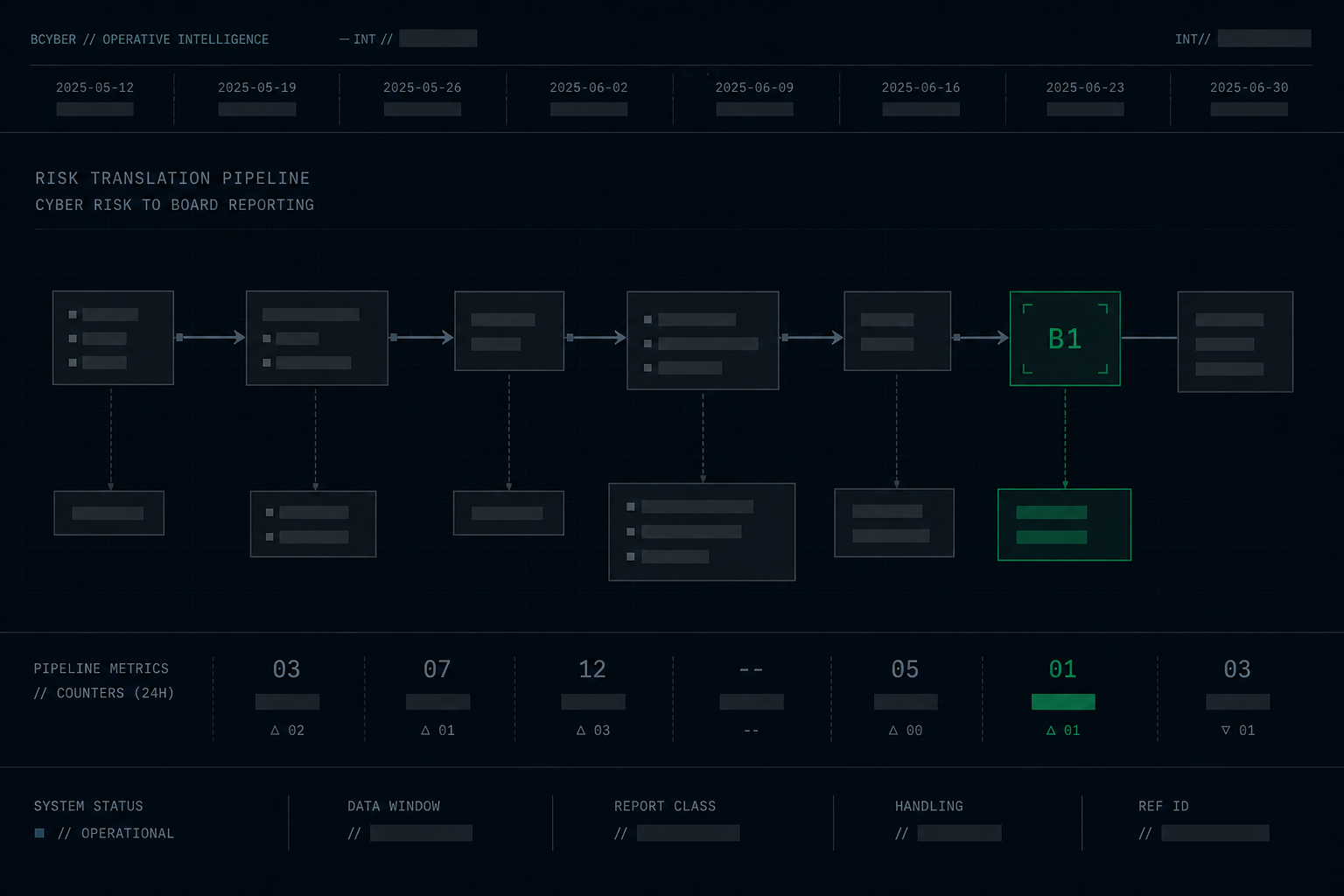
Board communication changed as well. Rather than presenting raw technical findings, the CISO reported in terms of financial exposure, operational impact, regulatory consequence, and trust. That made the conversation more useful because executives do not need packet traces to understand that an unavailable critical service affects customers, contracts, and continuity.
The reporting also became more decision-oriented, which reduced the risk of overwhelming the board with detail that did not change the decision. Good board reporting does not hide complexity; it distils it so leaders can act.
This is also where GRACE Portal becomes a practical executive layer: single-dashboard visibility, cross-product analytics, compliance tracking, and executive reporting help the CISO turn technical telemetry into governance language. In parallel, TopSpin supports storage forecasting and capacity planning, which is important in environments where logging growth, retention obligations, and evidence preservation can drive real cost and architecture decisions.
The leadership lesson here is subtle but important: influence without authority depends on clarity, consistency, and evidence. The CISO did not need to own every control to influence outcomes. Instead, the role was to create shared ownership of cyber risk across the enterprise and to show how security enabled business priorities such as continuity, digital change, and regulatory preparedness.
What changed once the strategy became an operating model?
The strategy only mattered because it became operational. The team did not rely on abstract principles; it created a phased roadmap with owners, timelines, and success criteria. Short-term fixes addressed obvious gaps, mid-term work improved capability, and longer-term investments strengthened resilience. That sequencing gave the organisation a way to show progress without pretending everything could be solved at once.
Which controls moved first?
The highest-value controls were the ones that supported visibility and containment. Identity and access management was tightened so privileged access was better controlled and reviewed. Asset inventory and visibility improved so the organisation could see what it needed to defend. Endpoint protection, logging, and backup assurance were lifted because they strengthen both detection and recovery.
When incidents did occur, response time mattered. BCyber’s CyberTriage platform is designed for AI-powered incident response with 4-minute triage, automated response, threat containment, forensic analysis, and incident playbooks. In a mature operating model, that kind of capability supports faster scoping and containment, especially when leadership needs to know whether the issue is local, systemic, or business-critical.
What metrics actually helped?
The organisation moved away from vanity metrics and toward measures that could inform decisions. It tracked items such as the percentage of critical vulnerabilities remediated, incident readiness indicators, control coverage for critical assets, and third-party risk closure rates. These measures were used because they showed progress, not just activity.
The point was not to count more things, but to count the things that changed risk. When metrics are designed this way, the board receives a clearer signal, and the security team can see where effort is creating movement.
Where did accountability sit?
Ownership was embedded across teams instead of living only inside the security function. Security tasks were attached to project and change processes, which meant risk decisions had to be considered where change was actually happening. That reduced the chance that a critical issue would be discovered only after a system went live or an audit began.
Why does culture matter as much as controls?
A security program can have strong policies and still fail if people do not understand their role in it. The CISO recognised that culture was not a soft extra; it was the mechanism that made the controls usable.
Security messaging shifted toward shared responsibility, so the business could see that cyber risk was not only an IT concern. That shift sounds modest, but it changes behaviour because people respond differently when they understand the “why” behind a control.
Awareness work also became more practical. Rather than relying on generic training modules, the organisation used role-based and scenario-based education. Staff in high-risk functions were shown the specific threats and decisions they were most likely to face.
This is where BCyber’s content and learning ecosystem supported change at scale. The platform inventory includes 85 courses, 1012 published articles, and 606 knowledge hub entries, giving organisations a practical base for sustained awareness rather than one-off campaigns. For example, role-based learning aligned to GRACE can be used to reinforce:
- governance and board literacy,
- risk and control ownership,
- assurance and reporting discipline,
- executive decision-making under uncertainty.
A mature program may use courses such as policy awareness, risk management, incident reporting, privacy practice, and resilience planning to support different roles. That is especially important in sectors like healthcare, where clinical staff need short, relevant guidance; in financial services, where executives need decision-grade reporting; and in government, where operational teams need clear process ownership.
The team also had to manage resistance. New governance rules and control changes often create friction because they alter habits, delay familiar workflows, or expose gaps that were previously invisible. The CISO handled that by explaining the business reason behind the change and showing early wins where possible.
What did the organisation learn, and what comes next?
The strongest lesson was that security strategy must be business-led, not tool-led. Once the organisation defined critical services, mapped dependencies, and attached evidence to its priorities, security decisions became easier to defend and easier to execute.
Governance improved because people knew what decisions were being made and why. Executive visibility improved because reporting became more useful. Audit readiness improved because evidence was built into the process rather than collected in a panic. None of that came from a single tool; it came from a leadership model.
Another lesson was that visibility into critical assets is foundational. If the organisation cannot see what it owns, what supports it, and what would fail first, then its strategy will always be incomplete. A third lesson was that metrics only help when they support decisions. Reporting for its own sake creates noise, but reporting that shapes action creates confidence.
Looking forward, the next maturity step is continuous assurance. That means more frequent testing, better use of automation and analytics, and a tighter loop between incidents, lessons learned, and control improvement. It also means paying closer attention to third-party and ecosystem risk as business dependency expands across cloud and SaaS environments.
BCyber platform context and trust notes
BCyber’s platform ecosystem is relevant to this case study because it maps well to an operating model that needs governance, evidence, and resilience:
- GRACE Portal for unified resilience visibility and executive reporting
- Paradigm for AI-driven GRC automation and compliance mapping
- Profiler for behavioural intelligence and insider risk analysis
- TopSpin for capacity planning and forecasting
- CyberTriage for rapid incident response and containment
- Perfect Storm for scenario modelling and resilience testing
- Privacy in Depth for Australian Privacy Act-aligned privacy management
BCyber’s stated industry recognition includes:
- 2025 Finalist Cybersecurity Professional Of The Year — Karen Stephens, Co-Founder & CEO
- 2025 GRC Provider of the Year — Finalist
- 2025 AI Innovator - Cyber Security — Finalist
These references are included for context and authority. As with any vendor-authored case study, readers should validate claims against their own control environment, risk appetite, and independent evidence.
Verification statement
The platform and inventory figures cited in this article are based on BCyber real platform data supplied for editorial enhancement: 23 policies, 9 processes, 85 courses, 2 enrollments, 1012 published articles, 606 knowledge hub entries, 12 clients, and 17 fact-find assessments. Where product capabilities are mentioned, they reflect BCyber’s published ecosystem descriptions. Readers should confirm implementation details directly with BCyber or through procurement and assurance reviews before adopting them in a live environment.Sources and authoritative references
For readers who want to validate the regulatory and control references used in this article, the most relevant public sources include:
- APRA CPS 234: Information Security — https://www.apra.gov.au/cps-234-information-security
- ACSC Essential Eight Maturity Model — https://www.cyber.gov.au/resources-business-and-government/essential-cyber-security/essential-eight
- ACSC Information Security Manual (ISM) — https://www.cyber.gov.au/resources-business-and-government/essential-cyber-security/ism
- NIST Cybersecurity Framework 2.0 — https://www.nist.gov/cyberframework
- NIST SP 800-53 Rev. 5 — https://csrc.nist.gov/publications/detail/sp/800-53/rev-5/final
- ISO/IEC 27001 overview — https://www.iso.org/standard/27001
- OAIC Australian Privacy Principles — https://www.oaic.gov.au/privacy/australian-privacy-principles
Key Takeaways
CISO strategy and leadership work best when they are grounded in business reality, not just technical activity. The most effective programs start with critical services, known dependencies, and material risks, then build governance and evidence around them. Strong board reporting translates cyber risk into business terms, while operational accountability ensures that priorities do not stall between teams.
The practical lesson is that a mature CISO does more than manage tools. They shape decisions, create shared ownership, and build an operating model that improves over time. In the Australian context, that means aligning with expectations from APRA CPS 234, the Privacy Act 1988, the APPs, and the Essential Eight where relevant. It also means admitting limits, showing evidence, and keeping the program honest about what is known, what is not yet known, and what still needs to improve.
The strongest CISOs do not just defend the enterprise; they help lead it.
If you want, I can also convert this into:
- a more SEO-focused case study page, or
- a shorter executive-summary version for the GRACE Portal website.